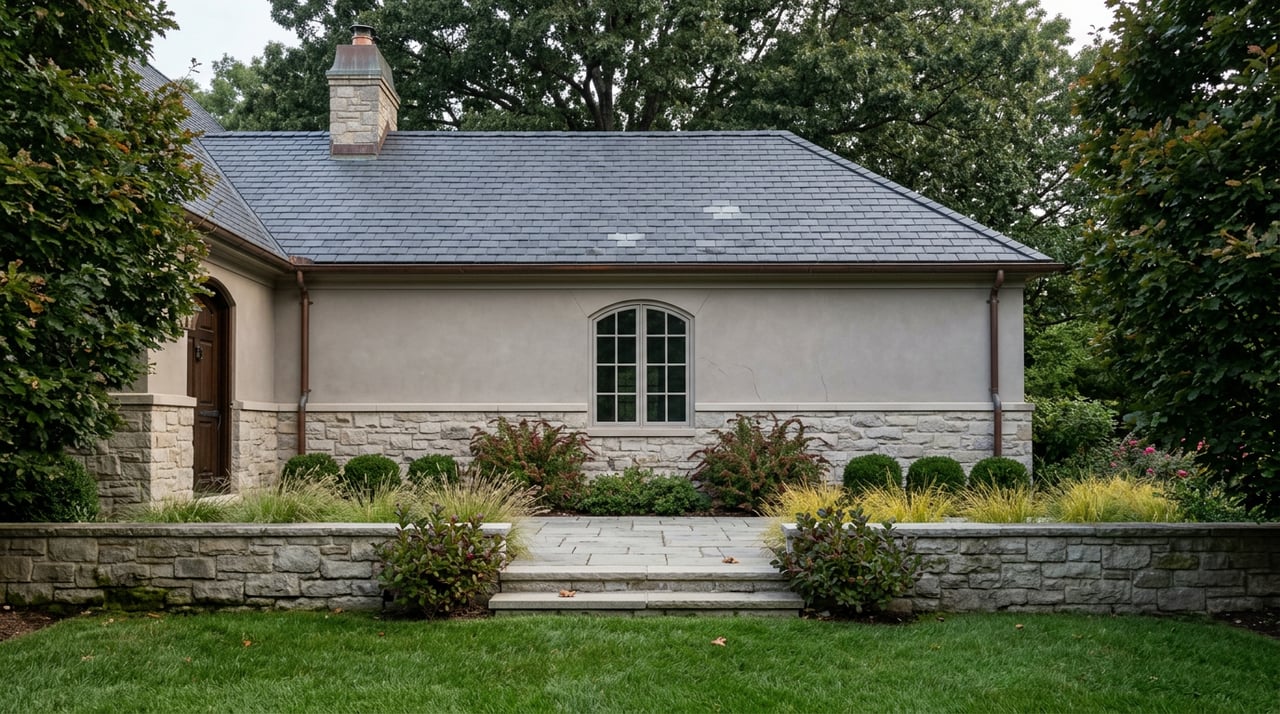
Winnetka Lakefront Bluff Regulations for Buyers and Sellers
August 13, 2026
August 13, 2026
The Real Deal's January 2026 report describes how Winnetka's steep-slope construction ordinance was functioning nearly two years after the village passed it in February 2024. For buyers considering a Sheridan Road property, the status of existing structures is one factor to consider alongside plans for new construction.
The ordinance exists because of one property. In 2023, private equity investor Justin Ishbia combined three lakefront parcels into a single 3.7-acre site and cleared the bluffs to make way for a mansion project The Real Deal reported at $77 million. Trees came down, the bluff was leveled, and Sheridan Road neighbors watched cranes go up where a natural bluff line used to run. The village council responded first with a permit abeyance period in July 2023, then with a full ordinance, MC-01-2024, passed 5-0 that February. Winnetka had been the only North Shore town without steep-slope regulations. Now it has some of the strictest.
Here's what enforcement looked like as of January 2026, according to village records reviewed by The Real Deal. Since the ordinance took effect in February 2024, at least 11 permit applications had been filed for work in the steep-slope zone. Four were approved. Two homeowners withdrew rather than continue through the review process. Five were still sitting in review, one of them for more than a year at the time of that reporting.
Run the math on those numbers and the odds of a clean approval sit close to one in three, and even the wins aren't quick. Michael Rauchman, owner of 645 Sheridan Road, applied in February 2024 to build a new $4 million residence. Village reviewers sent his plans back over a proposed gazebo replacement and a sewer line routed through the steep-slope zone. It took four rounds of revisions and until October 2024, eight months, before he got a yes. As of the January 2026 reporting, he remained a plaintiff in the homeowners' lawsuit against the village, which claims the ordinance cost his property 6,300 square feet of developable land and roughly $3 million in value.
Other reported examples involved smaller projects. Village reviewers turned down a retaining wall design because its flat top effectively created new usable backyard space, which the ordinance treats as an illegal extension of the yard. A homeowner's plan to replace an existing stone terrace with a new one was blocked because the new design extended four feet past the original footprint. These examples involved maintenance-scale projects rather than teardown-and-rebuild proposals, and they too were subject to review under the ordinance.
Not everything on a bluff-top lot needs this level of review. The village's own lakefront regulations page carves out a short list of construction activity that does not require steep-slope review:
Yahoo News reported that the framework named specific allowances within the steep-slope zone: boathouses up to 860 square feet and 15 feet tall with rooftop decks permitted, decks capped at 50 square feet, stairs, and existing structures rebuilt or remodeled on their current foundations. Any buyer or seller should confirm current allowances directly with the village's community development department before assuming a project qualifies.
Here's the wrinkle that matters most if you're evaluating a listing rather than filing a permit. The ordinance places restrictions on new work, but it was written to protect what's already standing. Patch reported that Trustee Kim Handler pushed through language allowing legally nonconforming structures in the steep-slope zone to be rebuilt as-is without a variance when they're damaged Handler pointed out that this isn't available to any of the village's other roughly 4,300 households, who'd have to go through a full variance process if their kitchen or garage needed to be torn down and replaced.
That means a decades-old boathouse, terrace, or lower-level addition sitting in a nonconforming footprint on a lakefront lot carries real, protected value that a brand-new version of the same structure wouldn't get. An architect's case study submitted to the village council, using a 1.25-acre bluff-top parcel that sold in 2020 as its test site, found the ordinance would cut 37 percent of the site's buildable area, push new construction 56 feet farther from the water, and eliminate the option of a walk-out basement with lake-facing windows on a fresh build. None of those restrictions apply to a structure that's already there and undamaged.
The practical result: the same square footage is worth more if it already exists than if you're planning to build it. That's not how lakefront value usually works, and it's the reason 25 lakefront homeowners sued the village in federal court in 2024 over what they call a taking of property value without compensation. A judge dismissed that initial complaint in October 2025, and a new suit followed shortly after, so as of the most recent reporting the legal question remained open. Winnetka's village attorney, Peter Friedman, has maintained the ordinance's requirements are clear and that staff is committed to a smooth, responsive process for the property owners going through it.
Part of what makes Winnetka's rule feel new is that it arrived last. Kenilworth, Highland Park, Glencoe, and Lake Bluff all had steep-slope regulations in place before Winnetka's 2024 ordinance, and each defines the protected zone a little differently. Kenilworth's steep-slope zone starts at the water's edge and extends inland. Glencoe measures from the toe of the bluff up to the tableland at the top. Winnetka's bluffs also vary more than its neighbors, ranging from 25 to 70 feet in height along different stretches of shoreline, a point the marine engineer who presented to the village council raised as a reason Winnetka couldn't simply copy a neighboring town's rulebook.
One other technical change worth knowing if you're evaluating a lot line: Winnetka used to measure the front lot line on lakefront property from the water's edge itself, which shifts as lake levels rise and fall. The ordinance moved to a fixed reference point instead, the U.S. Army Corps of Engineers' ordinary high water mark, which was cited during deliberations at an elevation of 581.5 feet, giving buyers and appraisers a stable line instead of a moving target. Winnetka's zoning code now defines the front yard setback on lakefront lots as the toe of the bluff or 50 feet from that ordinary high water mark, whichever sits farther from the water.
If you're buying, the diligence list on a Winnetka lakefront property now needs a line item that didn't exist three years ago: ask whether any structure in the steep-slope zone is legally nonconforming, and get that documented before you close. A nonconforming boathouse or terrace with protected rebuild rights is an asset. The same structure built new may not be approvable in its current form. If you're planning any renovation that touches the bluff or table land, budget both time (the shortest approved timeline on record is measured in months, not weeks) and the possibility of multiple design revisions.
If you're selling, the burden shifts to proving what you have. A seller who can produce permit history, survey documentation, and confirmation that existing structures qualify for as-is rebuild rights gives a buyer more confidence about the property's status. That documentation is doing real work toward protecting your number, especially while the underlying legal fight over the ordinance remains unresolved. Our lakefront properties team walks sellers through exactly this kind of file before a listing goes live, and our home valuation process accounts for how nonconforming status affects a bluff-top property's number.
Is the bluff ordinance still being challenged in court? As of the most recent reporting, yes. A group of lakefront homeowners sued in 2024, had their initial complaint dismissed in October 2025, and filed a new lawsuit shortly after. The dispute over compensation for lost buildable land had not been resolved at that point.
Does the ordinance affect my whole lot, or just the bluff itself? Only the steep-slope zone, the area between the toe of the bluff and where the 27-degree slope line meets the tableland. Construction elsewhere on a lakefront lot follows Winnetka's standard zoning process.
What if my planned project is small, like a new terrace? Size doesn't exempt a project. Reviewers have rejected terrace and retaining wall proposals for extending just a few feet beyond the original footprint, so any change to grade or footprint in the steep-slope zone should assume full review.
Whether you're weighing an offer on a Sheridan Road estate or preparing one to list, the details of Winnetka's bluff ordinance are worth considering before making a decision. Jena Radnay has walked clients through this exact process since the ordinance took effect. Request a Private Consultation to talk through what it means for the property you're watching.
This article is general information, not legal, tax or financial advice. Consult a qualified professional about your situation.
Stay up to date on the latest real estate trends.
Jena Radnay, and the focus of her real estate business, is all about people. Radnay’s love for real estate, houses, marketing, and people have allowed her business to grow organically, albeit explosively, in large part from referrals from her extensive network of contacts and connections.
Let's Connect